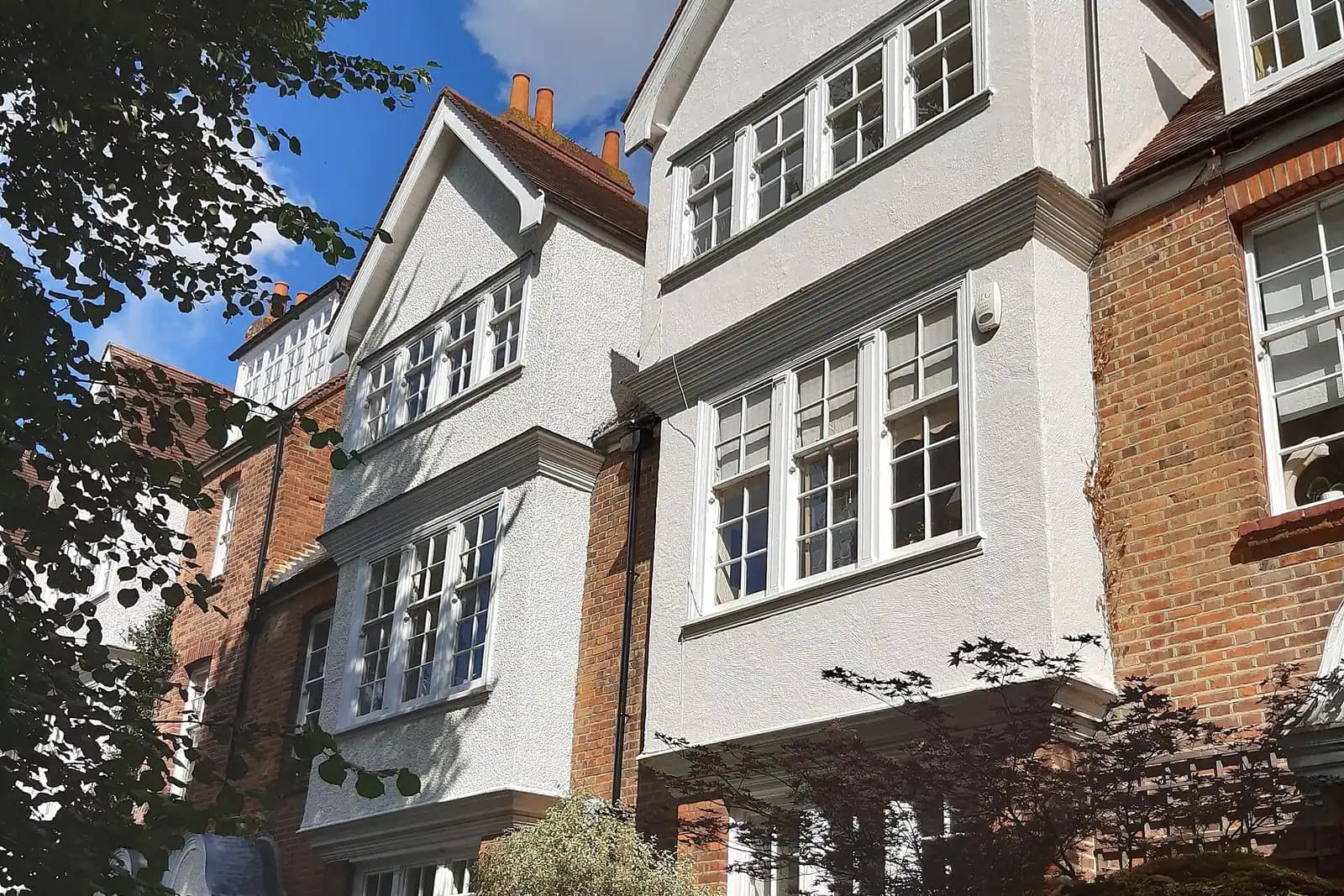
Search your council's online planning register for every past permission on your address and on the development it was built as part of, open each decision notice, and read the conditions. A condition that removes rights usually starts "Notwithstanding the provisions of the Town and Country Planning (General Permitted Development) Order" and then names the Classes it takes away. If none of your permissions has such a condition, conditions are not your problem. If one does, it overrides the national rules for the Classes it names.
On this page
The permitted development order is clear on that point: nothing in it permits development contrary to any condition imposed by any planning permission (GPDO 2015, article 3). Our broader post on checking whether your house has permitted development rights puts this check alongside the others; this one goes into it in depth.
Which houses in London are likely to have one?
Houses that came into being through a planning permission rather than before modern planning. In London that means mainly:
- Newer houses, from the 1970s on, especially on estates, in mews and backland plots, or as infill between older houses.
- Conversions, such as a mews building or a former commercial building turned into a house.
- Houses that had a large extension approved, where the council limited further additions.
- Townhouses on regeneration estates, built under an estate-wide permission. Our post on flats on regenerated estates covers that case.
A Victorian or Edwardian terrace that has never had an application is unlikely to carry a condition, though an Article 4 direction may still apply to its street.
Where do I find the condition?
On the council's planning register, not on your title and not on any national map. Every London borough has a searchable register online.
- Search by your address. Note every decision: full permissions, householder permissions and certificates.
- Search by the wider site. A house built as part of a development may sit under a permission registered to the original address, such as "Land rear of 12 to 20 High Road", or the estate name. Old Ordnance Survey maps and the house's first sale details help you find the old address.
- Open the decision notice. The summary list often omits conditions. Read the notice itself, every condition, including those with a heading such as "Permitted development".
- Check older records. Some councils hold pre-2000 decisions only as scanned microfiche or on request. If the online record is blank for an obviously modern house, ask the council's planning records team.

How do I read the wording?
Look for which parts and Classes of Schedule 2 it names. Government guidance says conditions restricting permitted development should be precisely defined by reference to the relevant provisions of the 2015 Order (MHCLG, Use of planning conditions, paragraph 017). In practice you will meet three kinds:
- All of Part 1, Schedule 2. Every householder right is gone: extensions, roof alterations, porches, outbuildings, hard surfaces.
- Named Classes. For example Classes A, B and E, removing extensions, roof enlargements and garden buildings, but leaving porches and some minor works.
- A specific element. For example "no windows other than those shown shall be inserted in the side elevation", which controls only that wall.
Match the named Classes against your project. Class A is extensions, Class B roof additions such as dormers, Class C other roof alterations such as rooflights, Class D porches and Class E garden buildings. A condition removing Class E alone does not touch your rear extension.
Older notices may cite an earlier order, such as the 1995 GPDO, whose Part 1 Classes followed a similar pattern. The condition still applies, but match the old Class letters with care; if unsure, ask the council.
Question 1 of up to 4
What type of property is it?
- Property
- Not answered yet
- Area
- Not answered yet
- Work
- Not answered yet
- Route
- Not answered yet
Does the condition still bind my house?
Usually, yes. A condition attaches to the land and binds every later owner, not only the developer. It continues unless it has been varied or removed by a later permission, or the original permission was never implemented. It does not lapse with age.
Check whether a later decision replaced it. A section 73 decision, or a fresh permission for the whole site, may have reissued the conditions with different wording.
What can I do if a condition removed my rights?
Three routes, depending on the project.
- Apply for planning permission for the project. The condition means the council wants to see it, not that the answer is no. A householder application costs £548 in council fees, and the officer judges the extension on its merits.
- Apply under section 73 to vary or remove the condition. Section 73 lets you apply to develop land without complying with a condition; the council considers only the conditions (TCPA 1990, section 73). The guidance helps your case where the condition is broad: area-wide or blanket removal of small-scale freedoms is unlikely to meet the tests of reasonableness and necessity (MHCLG, paragraph 017). This route suits an owner planning several projects over time.
- Apply for a certificate of lawfulness if you believe the condition does not cover your project, for example because it names other Classes. A certificate gives a legally binding decision (MHCLG, When is permission required, paragraph 024). Our certificate of lawfulness service prepares that application.
Our complete planning drawing service is £895 for the first route. If the condition rules nothing out, our free permitted development checker tests the project against the national limits and will tell you plainly when you need no application.
An illustrative example, not a real job: a 1990s house in a south London backland close was built under a permission whose condition removes "Classes A, B and E of Part 1". The owner wants rooflights at the back (Class C) and a porch (Class D). Neither is named, so both may still be permitted development, subject to the usual limits. A rear dormer would be Class B, so it needs an application.
Can you check it for me?
Yes. Our planning constraints report is from £19 for one address. It searches the planning history and lists the conservation area, Article 4, listed status and flood zone, in plain English. Where the register's history is incomplete online, we say so rather than calling it clear.
Work out your fee
FFP-01 · Rev Aor email hello@fixedfeeplans.co.uk
No obligation. Nothing is sent until you ask; your enquiry comes to us and nowhere else.
Frequently asked questions
The estate agent and the searches said nothing about a condition. Is my house clear? Not necessarily. Local authority searches list planning decisions but rarely spell out the conditions. Read the decision notices yourself.
Can a condition remove rights from flats? Flats have no householder permitted development rights to remove. Conditions on flats usually control specific features such as windows, balconies or roof use.
Does a condition last forever? It lasts until a later permission varies or removes it. It does not expire with time.
Can my neighbour's identical house have different rights? Yes. Houses built under separate permissions, or extended under different ones, can carry different conditions.
If the application goes through the Planning Portal, the Portal adds its own service charge: nothing, £99 or £149 including VAT, depending on the application type and complexity, paid to the Portal at submission and not normally refunded with a council fee (Ashford Borough Council, Planning Portal service charges, 11 September 2026). It is not ours and not the council's. Other submission routes exist; where your council accepts one without a charge, we can use it.