A householder planning application in England costs £548 for a single house, from 1 April 2026. The government sets that fee nationally and you pay it to the council at submission. New homes cost £610 each when fewer than ten are proposed. Fees rise each April.
Key Takeaways
- The householder fee is £548, an outbuilding or boundary application is £272, and a certificate of lawfulness for proposed work is half the full fee.
- The fee is the council's, paid when you apply. It is separate from what a designer or agent charges, and from building control.
- The free resubmission that used to follow a refusal or withdrawal was removed on 6 December 2023.
- A draft order would raise the householder fee again from 8 December 2026. It has not been made, so £548 stands today.
How much does planning permission cost in England?
The fee depends on what you are building, not on how long the council takes or how much the work costs. For a house extension or alteration it is £548. The figures below come from the government's fee schedule in force from 1 April 2026, checked on 13 October 2026.
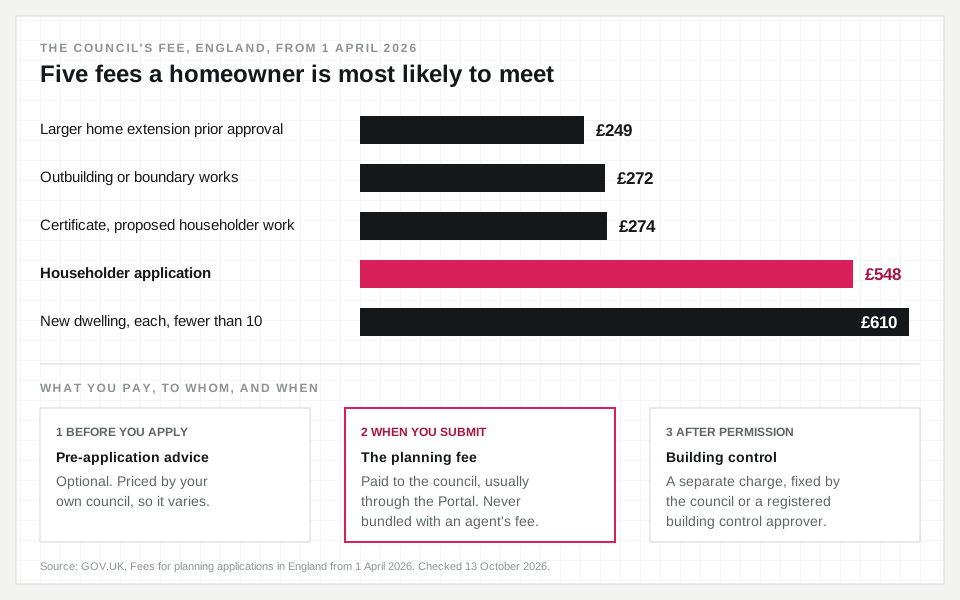
Fees are set in the Town and Country Planning (Fees for Applications, Deemed Applications, Requests and Site Visits) (England) Regulations 2012. Since the 2023 amendments, regulation 18A raises the fees in the schedule each 1 April by the September CPI rise, if CPI has risen, capped at 10 per cent and rounded to the nearest pound. September 2025 inflation was 3.8 per cent, which is how this year's schedule was reached.
What are the planning application fees for 2026?
This table lists the fees a homeowner or small developer is most likely to pay. Every figure is from the GOV.UK schedule effective 1 April 2026. The applicant pays the council in each case, when the application is submitted.
| Application | Fee | Notes |
|---|---|---|
| Householder: extend or alter one dwellinghouse | £548 | The fee most people mean by "planning permission cost" |
| Householder: two or more dwellinghouses | £1,083 | One application covering several houses |
| Outbuilding, gate, fence, wall or other boundary enclosure in the grounds of a house | £272 | For purposes ancillary to the home |
| New dwellings, fewer than 10 | £610 each | Full application, not outline |
| New dwellings, 10 to 50 | £659 each | |
| Change of use to dwellinghouses, fewer than 10 | £610 for each additional home | Where one house is split into several. Other material changes of use are a flat £610 |
| Larger home extension prior approval | £249 | Permitted development route, Part 1 Class A |
| Certificate of lawfulness, proposed work | Half the full fee, £274 for a householder project | Section 192 |
| Certificate of lawfulness, existing use or work | Same as the full application fee (£309 where only a breach of condition is to be certified) | Section 191 |
| Remove or vary a condition, householder | £89 | |
| Discharge a condition, householder | £89 | £309 in any other case |
| Non-material amendment, householder | £46 | £309 in any other case |
Larger and mixed schemes have their own categories, including outline applications priced per 0.1 hectare. If your project is not on this list, the Planning Portal's fee guidance and our fee calculator show the category it falls into.
Two points catch people out. The householder fee covers enlarging or altering a house, while a garden room or shed falls in the outbuilding line. The Planning Portal says no application fee is required for listed building consent.
How much is a lawful development certificate?
A certificate for proposed work costs half the full application fee, so £274 for a householder project. A certificate for something already built costs the same as the full application fee. The council charges it when you apply.
The certificate proves lawfulness but does not grant permission. Our guide to certificates of lawfulness explains sections 191 and 192 and the evidence councils expect. If you only need to know whether a project needs an application at all, the permitted development checker is free and does not push you towards a paid route.
What does the Planning Portal charge on top?
Applications submitted through the Planning Portal carry a separate service charge when the council fee is above a threshold. It is paid to the Portal, not the council, and it is not part of any figure in the table. The Portal sets the charge in bands, so check its own page on costs for today's amount before you budget.
Is the planning fee refunded?
Only in set circumstances. An application the council cannot validate has its fee returned: the GOV.UK fees guidance says the authority "must notify and return the fee to the applicant". Once the application is valid, the fee is generally not refundable, whether the outcome is approval or refusal.
The other route is the Planning Guarantee. Under regulation 9A, the council must refund the fee if it fails to determine a valid application in time: 16 weeks for non-major applications, including householder ones, and 26 weeks otherwise. There is no refund where you agreed an extension in writing, where you appealed or the Secretary of State called the application in before the deadline, or where someone has applied to the High Court. The guarantee covers planning applications and reserved matters, not certificates or prior approval.
Can I resubmit for free after a refusal?
No. England used to allow one free repeat application within 12 months of a decision or withdrawal. The Explanatory Memorandum to SI 2023/1197 describes that "free go" and says the 2023 regulations removed it for applications made from 6 December 2023. Regulation 9, which carried the exemption, shows as omitted from 6 December 2023.
Older advice online still promises a free second go. Treat it as out of date. A refused scheme that you amend and resubmit now pays the full fee again, which is the strongest argument for getting drawings and officer advice right before the first submission.
Who sets pre-application fees?
Each council sets its own, so the same query can cost very different amounts depending on the borough. Pre-application advice is optional and the government's fee schedule does not cover it. When we checked on 13 October 2026, the Royal Borough of Kingston charged £174 for written advice on a house alteration, or £300 for a meeting plus written advice, including VAT, on its pre-application fees page. Islington listed £480 including VAT for written advice on a single house or flat on its pre-application advice fees page.
Bromley's pre-application fees page lists £250 for householder proposals, with fees effective from 5 February 2024, so confirm the current amount with the council. Our pre-application advice request service is £295, and the council's own charge is paid separately to the council.
What is charged separately from the planning fee?
Three costs sit alongside the council's planning fee, and none of them is included in it:
- Building control. Approval under the Building Regulations is separate. GOV.UK says its charges are fixed locally under separate legislation. Our building regulations drawings service prepares the submission.
- Pre-application advice. Optional, and priced by each council, as above.
- Drawings and an agent. Someone has to produce the survey, plans and forms. That is not a council fee.
How do our fee and the council's fee fit together?
They are two bills, from two parties, and we never add them into one headline number. Our planning application, complete service is £895 in five published stages, and every stage price is on the price list. The council's £548 fee for a house extension goes to the council through the Portal, and the receipt comes to you.
For a worked estimate of both parts for your own project, use the fee calculator. For a comparison of what the wider market charges for drawings in London, see the cost guide.
Will planning fees go up again?
Possibly. A draft Statutory Instrument laid in 2026, The Town and Country Planning (Fees for Applications, Deemed Applications, Requests and Site Visits) (England) (Amendment and Transitional Provision) Regulations 2026, would set the single-dwelling householder fee at £575 and new dwellings at £752 each. It would come into force on 8 December 2026. As of 13 October 2026 it is a draft that has not been made as a statutory instrument, and it replaces an earlier draft laid on 16 July 2026. Its figures may change before it is made.
Until an order is made, the fees in the table apply. Which applications it would affect depends on its transitional provision, so read the final order if it is made. Nothing in the draft changes what you pay today.
Frequently asked questions
How much is a householder planning application?
It is £548 for one dwellinghouse from 1 April 2026, and £1,083 where the application covers two or more. Outbuildings, gates, fences and walls in the grounds are £272.
Do I get my planning fee back if the application is refused?
No. Once validated, the fee is generally not refunded, whatever the decision. It is returned if the council cannot validate the application, or refunded under the Planning Guarantee if a valid application is not decided within the 16 or 26 week period and you have not agreed an extension.
Is there still a free resubmission within 12 months?
No. The free repeat application was removed from the Fees Regulations with effect from 6 December 2023, so a resubmission pays the full fee.
Does the planning fee include building regulations?
No. Building control charges are set locally and paid separately. See what is charged separately.
When will the householder fee change?
Fees are indexed each 1 April. A draft order would raise the householder fee to £575 from 8 December 2026, but it has not been made as of 13 October 2026.
Sources
All retrieved 13 October 2026.
- GOV.UK, Fees for planning applications in England from 1 April 2026 (schedule): https://assets.publishing.service.gov.uk/media/69a073bb07d7bff3604d6df6/Planning_fees_-_annual_indexation_from_1_April_2026.pdf
- GOV.UK, Fees for planning applications (guidance, updated 16 April 2025): https://www.gov.uk/guidance/fees-for-planning-applications
- Town and Country Planning (Fees for Applications, Deemed Applications, Requests and Site Visits) (England) Regulations 2012, regulations 9, 9A and 18A: https://www.legislation.gov.uk/uksi/2012/2920
- SI 2023/1197 and its Explanatory Memorandum (removal of the free go; Planning Guarantee at 16 weeks): https://www.legislation.gov.uk/uksi/2023/1197/pdfs/uksiem_20231197_en_001.pdf
- Draft Amendment and Transitional Provision Regulations 2026 (not made): https://www.legislation.gov.uk/ukdsi/2026/9780348286625
- Planning Portal, What it costs: https://www.planningportal.co.uk/planning/planning-applications/how-to-apply/what-it-costs/
- Royal Borough of Kingston upon Thames, Islington Council and London Borough of Bromley pre-application fee pages, as linked above.