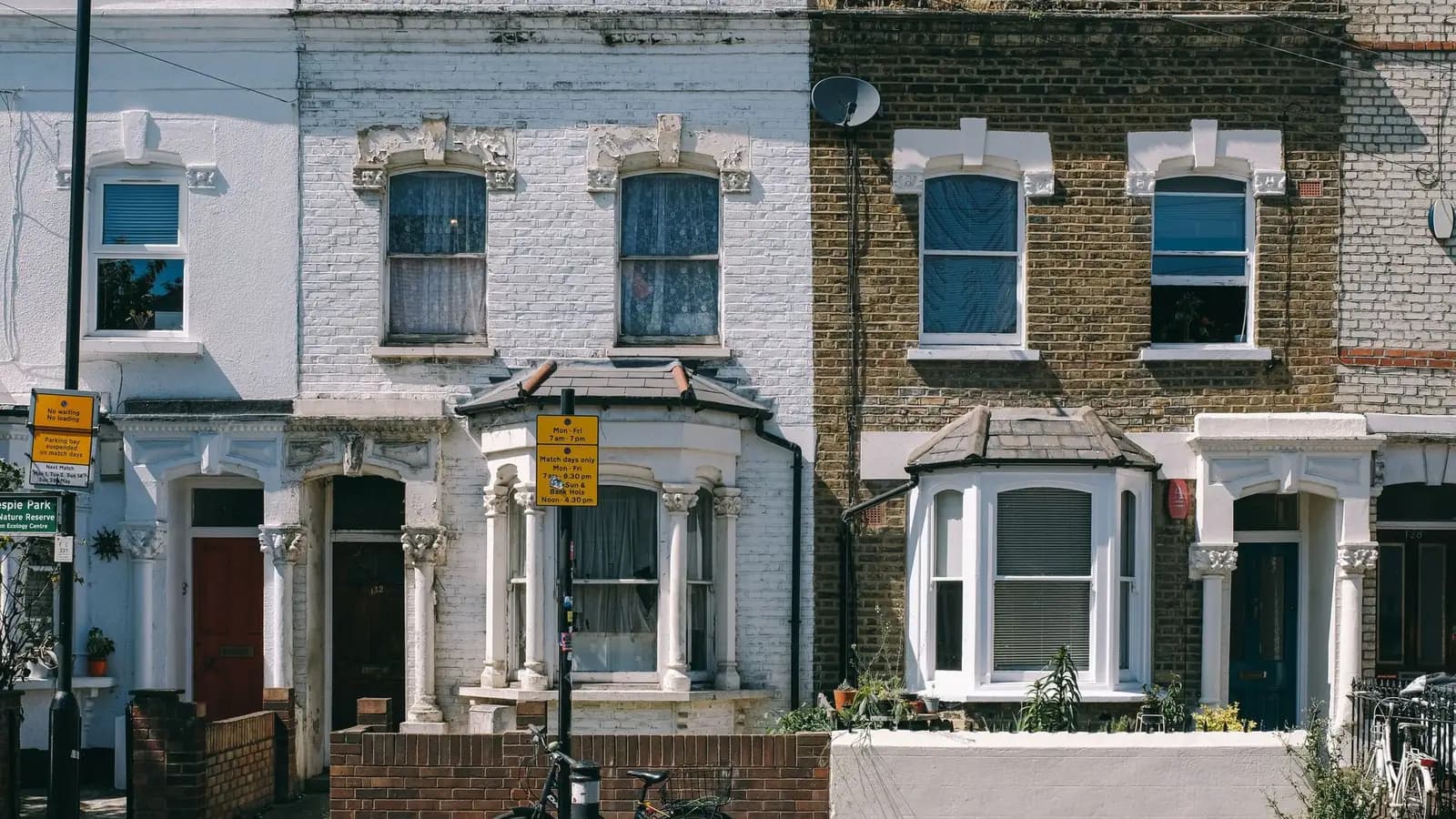

A house in multiple occupation is Use Class C4 when it has no more than six residents, and sui generis when it has seven or more. A single household stays in C3. Mandatory licensing is a separate test: it starts at five occupants forming two or more households, whatever the planning class says.
Planning decides whether a building may be used as an HMO at all. Licensing decides whether it may be let, to how many people, in rooms of what size. A landlord can pass one and fail the other, so this guide takes them in turn.
Key Takeaways
- Class C4 covers an HMO with not more than six residents. Seven or more is outside the use classes and needs a planning application.
- Class L of the GPDO lets a home move between C3 and C4 without an application, but an Article 4 direction can switch that off.
- 16 of the 22 London boroughs with a live page on this site list an HMO Article 4 direction.
- A mandatory licence applies at five or more persons in two or more households.
- A licensed bedroom for one person over ten must be at least 6.51 sq m, and rooms under 4.64 sq m cannot be slept in.
Which planning use class does an HMO fall into?
An HMO with not more than six residents is Use Class C4. A home occupied by one household is C3. An HMO with seven or more residents fits neither class and is sui generis, meaning "of its own kind". Moving up a step is a change of use, which needs a decision from the council unless a permitted development right applies.
The wording is in the Use Classes Order 1987. Class C4 is "use of a dwellinghouse by not more than six residents as a house in multiple occupation", and the term takes its meaning from section 254 of the Housing Act 2004. That test asks whether the occupants form a single household, whether it is their only or main residence, whether rent is paid, and whether households share a toilet, washing or cooking facility. GOV.UK puts it more plainly: an HMO is a property rented by at least 3 people who are not from one household.
C3 stretches beyond a family: it includes up to six residents living together as a single household, with or without care. The Planning Practice Guidance explains what sui generis means and notes that changes to or from such uses generally need an application.
Splitting a house into self-contained flats is a different change again. Section 55(3)(a) of the Town and Country Planning Act 1990 treats using one dwelling as two or more separate dwellings as a material change of use, so it needs planning permission. Our post on converting a house into flats in London covers that route.
| Occupancy | Planning class | Move from a normal home | Mandatory licence |
|---|---|---|---|
| One household, any composition | C3 | Not applicable | No |
| Not a single household, up to six residents | C4 | Class L, unless an Article 4 direction applies | Only at five or six residents in two or more households |
| Seven or more residents | Sui generis | Planning application | Yes, at five or more in two or more households |
Does Class L let you convert a house to a small HMO without planning permission?
Yes, unless the council has removed the right. Class L in Part 3 of Schedule 2 to the GPDO permits a change from C3 to C4 and from C4 back to C3, with no conditions attached. It does not reach seven-person HMOs, which are not in C4, so that jump needs a planning application.
Class L has one exclusion, paragraph L.1: the right does not apply where the change would produce two or more separate dwellinghouses from one HMO, or two or more separate HMOs from one dwellinghouse. Splitting a house into two small HMOs is therefore a planning matter even where Class L is intact.
Because Class L carries no conditions, no fire or amenity check sits inside it. Those belong to licensing and building regulations, and they still apply.
What is an Article 4 direction and how common are they in London?
An Article 4 direction withdraws a permitted development right in a defined area, so the change needs a planning application. Article 4(1) of the GPDO lets the council do this for any class in Schedule 2. Of the 22 boroughs with a live page on this site, 16 list an HMO direction.
That is a count of our own pages, not a London-wide survey. The ones that list a direction are Croydon, Ealing, Bromley, Havering, Harrow, Redbridge, Bexley, Waltham Forest, Brent, Greenwich, Merton, Haringey, Southwark, Newham, Tower Hamlets and Barking and Dagenham. Wandsworth, Richmond, Kingston, Islington, Kensington and Chelsea and Westminster list none.
Scope varies. Some directions cover a whole borough, some named wards (Haringey, Merton), some a mapped area (Brent, Tower Hamlets), and Southwark's covers two named streets. Read the ward or map, not the headline.
Timing matters. A non-immediate direction needs a representation period of at least 21 days and cannot take effect until confirmed. An immediate direction covering Part 3 lapses after six months unless confirmed, which is why our Harrow page carries a confirmation deadline. A direction does not ban HMOs: the Planning Practice Guidance says it means an application is needed.
When does an HMO need a mandatory licence?
A mandatory HMO licence is needed when five or more people live in the property as two or more separate households. The rule is in article 4 of the 2018 prescribed description order and applies from 1 October 2018. It counts people and households, not bedrooms or the planning class.
The 2018 order sets three conditions: five or more occupants, living in two or more separate households, and a building that meets the standard, self-contained flat or converted building test. A purpose-built flat in a block of three or more self-contained flats is outside the flat test. GOV.UK adds that a licence lasts up to 5 years and that letting a licensable HMO without one risks an unlimited fine.
Five or six sharers are therefore C4 for planning and licensable. Fewer than five are not caught by the mandatory rule, though your council may still require a licence under the schemes below.
What are the minimum room sizes for a licensed HMO?
A licensed HMO must give each sleeping room at least 6.51 sq m for one person over ten, 10.22 sq m for two people over ten, and 4.64 sq m for one child under ten. A room under 4.64 sq m cannot be slept in. Floor under a ceiling lower than 1.5 m is not counted.
Those figures are mandatory licence conditions added by the 2018 regulations, in force from 1 October 2018. The licence must also cap how many people may sleep in each room. A room counts as sleeping accommodation if it is normally used as a bedroom, even if it has other uses.
This is where drawings earn their keep: a scaled plan with every room's area and use marked, and the 1.5 m rule applied to sloping ceilings. Our loft Part B guide covers the fire side of an attic bedroom. Kitchen and bathroom standards are not in these regulations, so check your council's before you fix a layout.
What are additional and selective licensing?
Additional licensing lets a council require a licence for smaller HMOs than the mandatory rule catches. Selective licensing extends licensing to privately rented homes that are not HMOs. Each is a designation the council makes for its whole district or part of it, after consultation.
Under section 56, additional licensing needs the council to consider that a significant proportion of those HMOs are managed sufficiently ineffectively to cause problems for occupiers or the public. Under section 80, selective licensing needs low housing demand, a significant and persistent anti-social behaviour problem, or a further condition set by order.
The practical consequence is that licensing is borough-specific: a three-person share can be unlicensed in one borough and licensable in the next. The licence fee is paid to your council.
What do HMO drawings need to show, and what do they cost?
HMO drawings show every room with its area, use and occupancy, the amenities, the escape routes and the fire detection layout, drawn to the council's validation and licensing standards. Our HMO drawings service is from £1,500, a published price, with the council's own fees shown separately.
The package covers licensing layouts, room areas, amenity standards and a fire strategy plan. Where a planning application is needed, the council's fee is passed through at cost and the receipt goes to you. For a licence plan alone, on a home that is already let, the landlord floor plans service is from £350.
Before paying for anything, read your council's Article 4 map for the address. Our permitted development checker applies the national limits, including the C3 to C4 change, and says plainly when no application is needed. C4 use that predates a direction is a job for a certificate of lawfulness, and the guide on whether you need planning permission covers extensions.
Frequently asked questions
Do I need planning permission to let a house to four sharers?
Only where an Article 4 direction covers the address. Elsewhere Class L allows C3 to C4, and four residents is within the six-resident limit. Licensing is a separate question.
Does a licence replace planning permission?
No. The licence is granted under the Housing Act 2004 and says nothing about planning.
Sources
All retrieved 10 October 2026.
- Town and Country Planning (Use Classes) Order 1987, Schedule 1 Part C (Classes C3 and C4): https://www.legislation.gov.uk/uksi/1987/764/schedule/part/C
- Town and Country Planning (General Permitted Development) (England) Order 2015, Schedule 2 Part 3, Class L: https://www.legislation.gov.uk/uksi/2015/596/schedule/2/part/3
- GPDO 2015, article 4 (directions restricting permitted development): https://www.legislation.gov.uk/uksi/2015/596/article/4
- GPDO 2015, Schedule 3 (Article 4 procedures, paragraphs 1 and 2): https://www.legislation.gov.uk/uksi/2015/596/schedule/3
- Planning Practice Guidance, When is permission required? (use classes, sui generis, Article 4): https://www.gov.uk/guidance/when-is-permission-required
- Housing Act 2004, section 254 (meaning of house in multiple occupation): https://www.legislation.gov.uk/ukpga/2004/34/section/254
- Housing Act 2004, sections 56 and 80 (additional and selective licensing): https://www.legislation.gov.uk/ukpga/2004/34/section/56 and https://www.legislation.gov.uk/ukpga/2004/34/section/80
- The Licensing of Houses in Multiple Occupation (Prescribed Description) (England) Order 2018, article 4: https://www.legislation.gov.uk/uksi/2018/221/article/4
- The Licensing of Houses in Multiple Occupation (Mandatory Conditions of Licences) (England) Regulations 2018, regulation 2: https://www.legislation.gov.uk/uksi/2018/616/regulation/2
- GOV.UK, Check if you need an HMO licence: https://www.gov.uk/house-in-multiple-occupation-licence
- Town and Country Planning Act 1990, section 55(3)(a) (one dwelling used as two or more), retrieved 18 October 2026: https://www.legislation.gov.uk/ukpga/1990/8/section/55
- Borough Article 4 directions: our own borough pages, each citing the council's page.